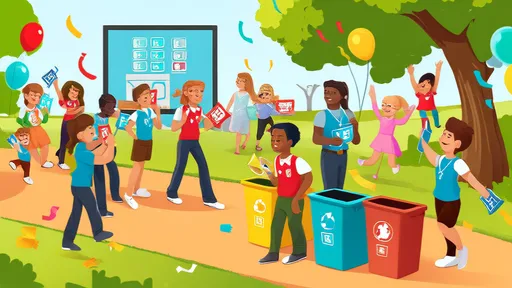
The concept of waste management has long been associated with dull routines and civic duty, but a growing number of communities are flipping the script. By integrating game mechanics into recycling programs, neighborhoods from Seoul to San Francisco are witnessing a surprising surge in participation rates. At the heart of this movement lies a simple truth: when sorting banana peels from beer bottles feels less like a chore and more like a challenge, people actually want to play along.
In Barcelona's Poblenou district, what began as a pilot program has blossomed into a full-fledged cultural phenomenon. Residents compete weekly to top the leaderboards of their building's recycling performance, with data collected through smart bins that recognize users via NFC chips. The winning family each month receives coveted discounts at local organic markets, but participants insist the real prize is the bragging rights. "My teenager finally cares about something other than his phone," laughs Maria Fernández, pointing to the digital dashboard in their lobby where her household currently holds second place. "Now he chases me to properly rinse every yogurt container."
The psychology behind these programs reveals why they work where traditional campaigns fail. Behavioral scientists note that immediate feedback loops—like seeing points accumulate in real-time—trigger dopamine releases similar to scoring in mobile games. Meanwhile, the social visibility of rankings taps into our innate desire for status within communities. Unlike abstract environmental warnings, these systems make the impact of proper waste disposal feel personal and measurable.
Singapore's "Recycle & Win" initiative takes this approach further by incorporating augmented reality. Scanning properly sorted items with a city app unlocks animated characters that explain recycling processes in engaging ways. Early data shows users spend an average of 47 seconds interacting with these educational elements per scan—dramatically higher than the 2-3 seconds people typically spend reading static recycling guidelines. The Ministry of Sustainability reports contamination rates in blue bins have dropped by 31% since launch.
Critics initially dismissed such programs as gimmicks, but the numbers tell a different story. Portland's gamified recycling system, implemented in 2021, has maintained a 72% sustained participation rate compared to the 28% average for traditional awareness campaigns. More strikingly, follow-up studies indicate these habits stick even when rewards phase out, suggesting the games successfully rewire daily behaviors. Environmental economist Dr. Lisa Yang attributes this to what she calls "the puzzle piece effect"—the satisfaction people derive from seeing their small action complete a larger system.
Technology companies are racing to develop increasingly sophisticated platforms for municipalities. The current generation of smart bins can now identify misplaced items through image recognition, offering instant correction with tutorial videos. Some experimental systems in Tokyo even use gentle haptic feedback—a rewarding vibration when depositing correctly sorted waste. This tactile reinforcement appears particularly effective with older demographics less inclined toward digital point systems.
Perhaps the most unexpected development has been the emergence of recycling as a spectator activity. In Malmö, Sweden, the annual "Waste Warriors" tournament draws crowds to watch teams compete in speed-sorting challenges, with commentary analyzing techniques as if it were an Olympic sport. The event's live-streamed finals last year attracted over 150,000 viewers, prompting the city to partner with a sports network for next season's broadcast. What began as a municipal program has inadvertently created a new form of eco-conscious entertainment.
As these initiatives spread globally, cultural adaptation proves crucial. Nairobi's version incorporates mobile money rewards instead of leaderboards, better suiting local preferences. Dubai's program ties recycling points to privileges at government facilities—a powerful motivator in the emirate's context. The common thread remains making environmental responsibility feel less like sacrifice and more like achievement. In an era of climate anxiety, that psychological shift might be the most valuable resource we recover.

By /Jul 29, 2025

By /Jul 29, 2025

By /Jul 29, 2025
By /Jul 29, 2025

By /Jul 29, 2025

By /Jul 29, 2025

By /Jul 29, 2025

By /Jul 29, 2025

By /Jul 29, 2025

By /Jul 29, 2025

By /Jul 29, 2025

By /Jul 29, 2025

By /Jul 29, 2025
By /Jul 29, 2025

By /Jul 29, 2025
By /Jul 29, 2025

By /Jul 29, 2025

By /Jul 29, 2025

By /Jul 29, 2025

By /Jul 29, 2025
